
The Prototyping Dilemma
Every hardware development project reaches a critical juncture when the focus shifts from theoretical design to physical validation. The cabling and wiring that connect your components are often an afterthought, but they can quickly become a bottleneck. Engineers face a fundamental choice: rely on readily available off-the-shelf cable assemblies or invest in custom prototype cable assemblies designed specifically for their application. Understanding the trade-offs between cost, speed, performance, and scalability is essential for making the right decision for your project's timeline and budget. This comparison explores the strengths and weaknesses of each approach, helping you determine the best path for your next prototype, whether it is for automotive, robotics, medical devices, or aerospace applications.
When Standard Cable Assemblies Make Sense
Off-the-shelf (OTS) cable assemblies are mass-produced, standardized products. They are the default choice for many early-stage prototypes because of their immediate availability and low upfront cost. If you simply need to pass a signal from point A to point B in a benchtop test, a standard HDMI, USB, or power cable will usually suffice. The primary advantage of OTS is speed. You can purchase them from any electronics distributor and have them in hand within days.
However, OTS assemblies come with significant limitations. They are designed for general consumer or commercial applications, not for the specific environmental, mechanical, or electrical demands of a unique product. They often take up too much space, require awkward routing, or lack the durability needed for industrial, automotive, or medical environments. For a proof-of-concept, they are often the fastest path, but they rarely represent the final product's wiring harness. Adhering to broad industry safety standards, such as those outlined by UL Solutions, is easier when you control the entire assembly, but OTS parts may not always meet the specific compliance needs of your target market. In regulated industries, relying on standard parts can introduce unexpected risks during certification.
The Advantages of Custom Prototype Cable Assemblies
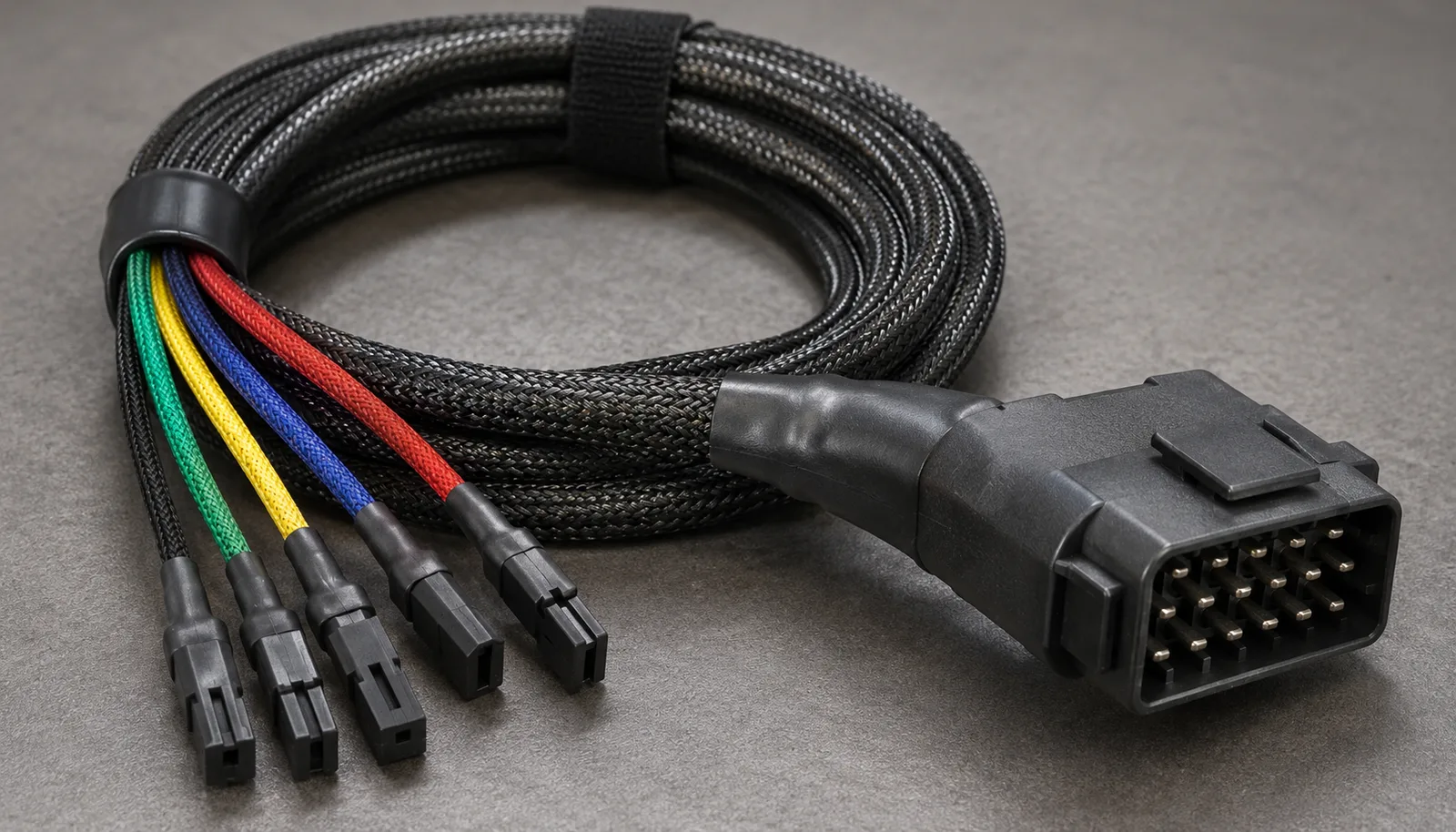
When your prototype needs to function reliably in the intended environment, custom assemblies become indispensable. A custom design allows you to specify every detail: conductor gauge, insulation material, connector types, overmolding, shielding, and overall length. This precision is critical for applications where space is at a premium, such as in robotics or aerospace, or where signal integrity is paramount, as in medical devices.
For projects demanding a perfect fit and specific performance, custom prototype cable assemblies offer a clear advantage. By working with a manufacturer like Cloom Tech, engineers can iterate quickly on designs. A custom assembly can be built to exact specifications, allowing for rigorous testing of the physical interface, flex life, and environmental resistance before committing to mass production. This approach aligns directly with design control processes recommended by regulatory bodies. For example, the FDA’s Design Control Guidance for Medical Devices emphasizes that prototype testing is essential for verifying that the device meets user needs and intended uses. Similarly, for automotive applications, meeting standards from organizations like SAE International often requires custom harnesses that can withstand high temperatures, vibration, and exposure to fluids. The ability to select materials and connectors specifically for these conditions is a significant advantage of the custom route.
- Address: 9251 NW 112th Ave Medley, Florida (FL) 33178 United States of America · Address details
- Email: [email protected]
The investment in a custom prototype cable assembly is an investment in the reliability and manufacturability of your final product.
Key Considerations for Your Decision
Choosing between OTS and custom assemblies depends on several project-specific factors. Evaluating these factors early in the design phase can prevent costly redesigns later. Here are the key elements to evaluate:
- Volume: For a single benchtop test, OTS is hard to beat. For 10 to 100 pre-production units, custom assemblies become cost-effective and necessary for validation.
- Timeline: OTS wins on immediate availability. Custom assemblies require a design phase and lead time for materials and manufacturing.
- Performance: If your product operates in a unique environment with high vibration, extreme temperatures, or a tight bend radius, custom is almost always required.
- Compliance: Custom assemblies can be engineered from the ground up to meet specific UL, CE, SAE, or FDA requirements, reducing risk during certification.
Partnering for Prototype Success
The best approach often involves a strategic combination. Start with OTS parts for initial proof-of-concept, then transition to custom prototype cable assemblies as you refine the design and move toward production validation. This allows you to de-risk the project while investing in the specific engineering required for success.
Partnering with an experienced manufacturer early in the design phase can streamline this transition. Cloom Tech, located in Medley, Florida, provides the engineering support needed to move from concept to custom prototype efficiently. By involving your manufacturing partner early, you ensure that your prototype cable assemblies are not only functional for testing but also scalable for the production line, saving time and money in the long run. A partner who understands the intricacies of custom wire harnesses and cable assemblies for industries such as automotive, robotics, medical devices, and aerospace can offer invaluable guidance on materials, connectors, and compliance requirements, turning a potential project risk into a competitive advantage.